
How We Review Monitors
Our Research-Based Verdict Process
Our Research-Based Verdict Process
Display Verdict is an independent review-authority site focused on computer monitors. Our verdicts come from desk research: we compare publicly available information from manufacturers, documentation, retailers, customer feedback, and independent reporting. We do not operate, handle, or physically test monitors, and we do not run lab measurements.
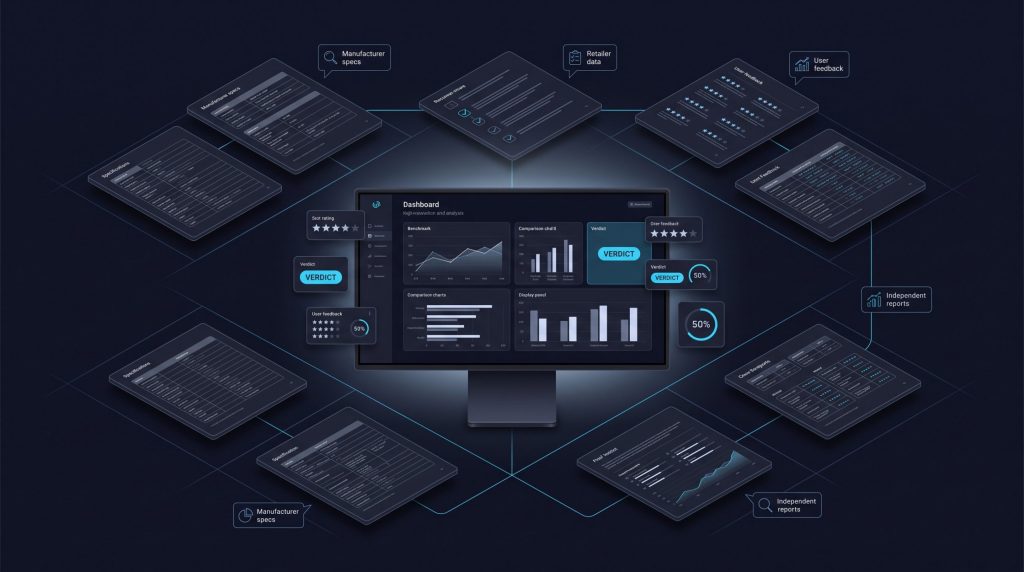
Our Four-Stage Review Process
Each monitor verdict follows a structured approach designed to deliver clear, actionable recommendations based on thorough desk research of publicly available information.
-
Define the Use Case
We identify the intended purpose—gaming, color-critical creation, office productivity, or mixed use—because the best monitor depends on the job it needs to do.
-
Collect and Cross-Check Facts
We gather key specifications from official product pages, spec sheets, manuals, and feature documentation, then verify pricing and availability from major retailers.
-
Evaluate Trade-Offs
We assess monitors using consistent criteria, noting where claims are unclear or where sources conflict, to surface meaningful differences.
-
Publish the Verdict
We state who the monitor is for, what compromises you're accepting, and what alternatives may fit better, creating a structured comparison of documented facts.
Evaluation Criteria We Prioritize
Our assessment focuses on the factors that typically move real-world satisfaction, drawing from manufacturer documentation, official specifications, and credible third-party reporting.
-
Image quality: panel type, resolution and scaling, contrast claims — Includes brightness, HDR support, color coverage, and calibration features as documented
-
Motion and gaming readiness: refresh rate support, variable refresh rate compatibility — Reported behavior from reputable third-party reviews when available
-
Ergonomics and build: stand adjustability, mounting support, durability-relevant design details — Drawn from manuals and product documentation
-
Connectivity and features: ports, bandwidth standards, USB hubs, KVM support, firmware features — As described by the vendor in official documentation
-
Ownership factors: warranty terms, dead-pixel policies, support reputation signals, long-term risks — Surfaced in credible reporting and aggregated customer feedback
Understanding Our Research Approach
Use our ratings as a starting point: a structured comparison of what's publicly documented and credibly reported.
Image Quality Evaluation
We examine panel type specifications, resolution and scaling documentation, contrast claims published by manufacturers, and brightness or HDR support as described in official materials. Color coverage or calibration features are assessed through vendor documentation, manuals, and feature lists to understand how each monitor is positioned for color-critical work versus general use.
Motion and Gaming Readiness
Our research covers refresh rate support as specified by the manufacturer, variable refresh rate compatibility documented in product pages, and reported behavior from reputable third-party reviews when available. We note where gaming-focused features like adaptive sync technologies are clearly described versus where claims remain vague or unsupported by detailed documentation.
Ergonomics and Build Quality
Our evaluation includes stand adjustability ranges, mounting support standards, and durability-relevant design details stated in manuals and product documentation. We note what manufacturers specify about construction materials, adjustment mechanisms, and long-term reliability indicators found in aggregated customer feedback.
Connectivity and Expansion
We document port configurations, bandwidth-relevant standards such as HDMI or DisplayPort versions, USB hub capabilities, KVM support where claimed, and firmware features described by the vendor. For creator workflows, we pay attention to whether daisy-chaining, multiple input switching, or dedicated calibration ports are specified and how those features align with professional requirements.
Ownership and Support Signals
Our research weighs warranty terms published by manufacturers, dead-pixel policies when stated, support reputation signals drawn from credible reporting, and long-term ownership risks surfaced in aggregated customer feedback. We note where documentation is transparent about coverage and return processes versus where key ownership details are absent or unclear in official materials.