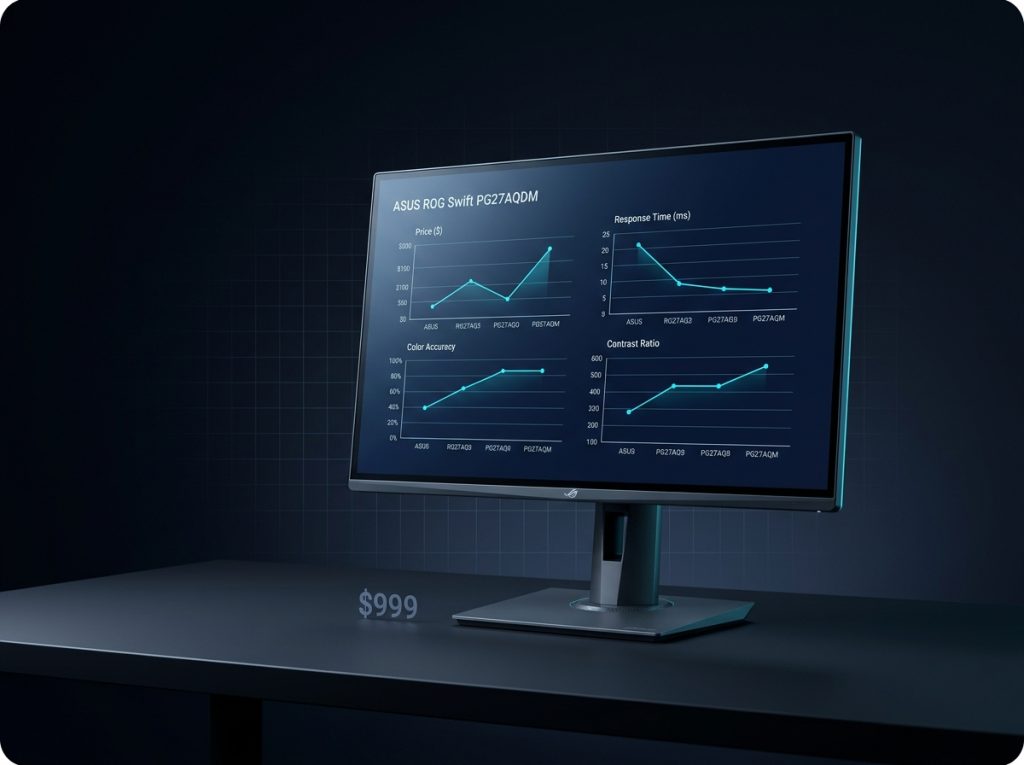
The PG27AQDM's case for competitive gaming rests on two headline numbers: 240Hz and 0.03ms GTG. A 240Hz refresh rate means frame pacing and the input pipeline become the limiting factors for many gaming PCs, and the claimed 0.03ms GTG response time is ASUS making a clear statement about OLED-class pixel transitions. Even if you treat any single response-time figure as a manufacturer simplification of complex behavior, the broader point holds: OLED panels are prized for near-instant transitions.
TechRadar's hands-on review describes the monitor as speedy and positions it as especially appealing to competitive gamers. For buyers who want the hard facts up front, those core specifications frame the PG27AQDM as a display built for motion clarity and immediacy, not for maximum pixel density or discount pricing.
With a WOLED panel and 99% DCI-P3 listed by ROG USA, the PG27AQDM is set up to deliver the saturated color and deep black levels people expect from OLED. The practical upside is straightforward: dark scenes gain depth, UI elements pop, and games with strong art direction look dramatic without needing aggressive tuning.
If you're weighing a broader purchase decision between 1440p and 4K for gaming, the PG27AQDM is a reminder that perceived image quality isn't only resolution. Contrast and color volume can matter just as much at a normal desk distance, and OLED's inherent strengths in those areas give this monitor a distinct visual signature.