LG Display's WOLED uses a white-emitting OLED layer combined with red, green, blue, and white subpixels. The white subpixel helps boost brightness and efficiency, while the RGB elements handle color accuracy. LG's newer Tandem WOLED stacks two RGB light sources, aiming for higher sustained brightness and improved power efficiency. The company highlights RGB-stripe subpixel structures as a key advantage for text rendering, positioning WOLED as a better fit for productivity tasks where UI clarity matters.
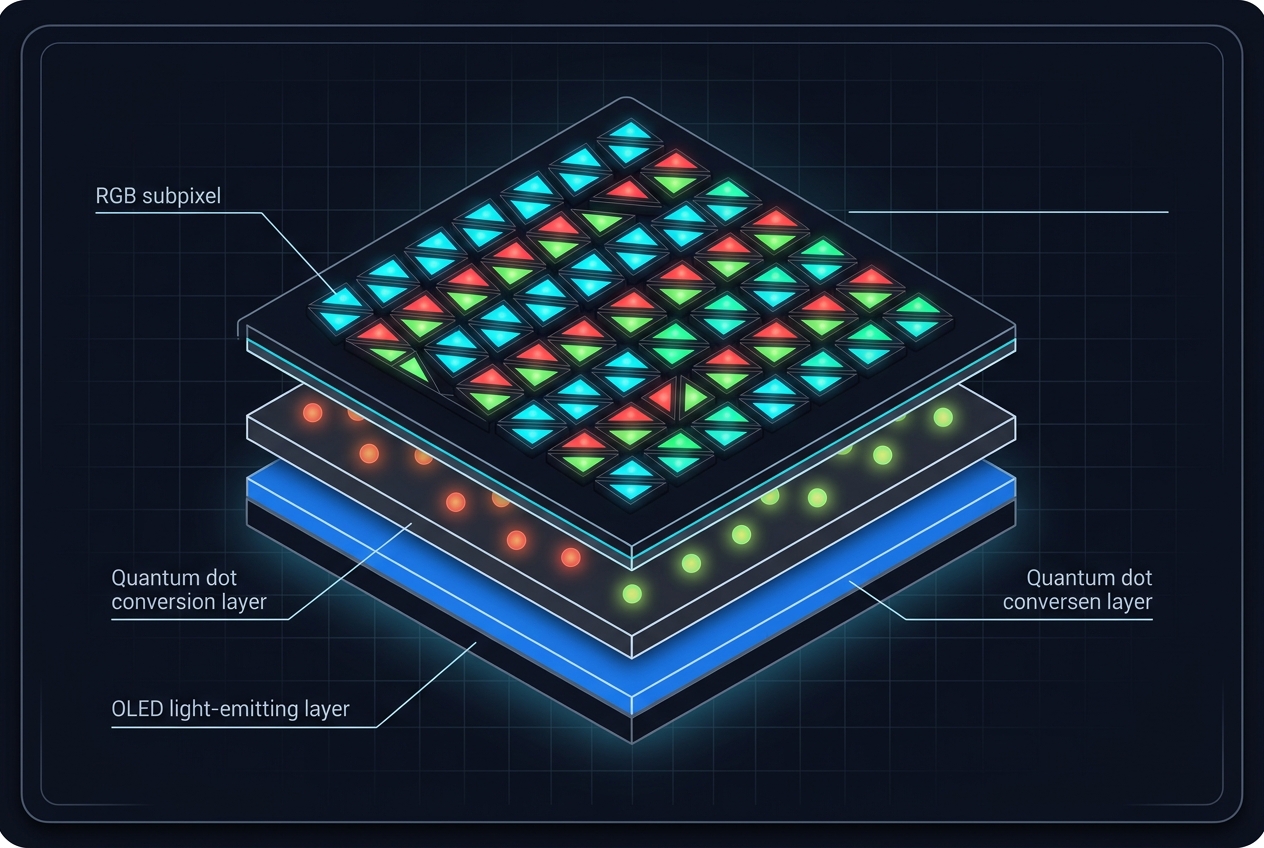
Samsung Display's QD-OLED takes a different approach: a blue OLED light source paired with quantum dots for color conversion. Quantum dots are nanometer-scale particles whose size determines emitted color, and Samsung argues that this conversion method improves color purity and light transmission compared to traditional color filters. The technology uses three subpixels instead of four, which contributes to its triangular subpixel arrangement—a layout that can affect text clarity in ways WOLED avoids.
TFTCentral notes that Samsung Display's QD-OLED panels have historically used a triangular RGB subpixel arrangement that can cause text clarity problems, with improvements coming via higher pixel density and newer panel designs. RTINGS.com points out that QD-OLED uses a triangular subpixel layout, and that WOLED subpixel order has changed across generations. If long sessions of spreadsheets, coding, or any workflow with lots of small UI text are part of the daily routine, this subpixel difference is why a monitor that looks amazing in games isn't always the full story.
For buyers who do photo editing or any work involving tone-sensitive content, OLED's automatic brightness limiting behavior and ambient-black performance still influence editing comfort. Dell's AW3225QF page claims Delta E less than 2 accuracy and 99 percent DCI-P3 coverage for its panel, and GIGABYTE lists DCI-P3 99 percent and 10-bit color depth for the AORUS FO32U2P. Those specs are attractive on paper, but OLED's ABL behavior, panel maintenance cycles, and ambient-black behavior still matter. For many photographers, OLED is a powerful secondary display for culling and proofing, while a calibrated IPS screen remains the safer primary when absolute consistency is the goal.